 by
by Bruce Krinsky of the company’s demise on LinkedIn: ‘It became a f…ing money pit‘
HIGH POINT — The owner and operator of Revival American Contract Furniture has gone on the record on social media about the July 31 closure of his upholstery manufacturing operation in High Point, citing factors ranging from the lack of skilled upholstery workers to U.S. government red tape and tariffs involving the importation of product.
In the end, he said, the venture consumed about $3 million of his and his wife’s cash, representing a overall effort “that consumed our time, attention and energy,” he said in a post about the closure on his LinkedIn page. Krinsky was not immediately available for further comment for this story.

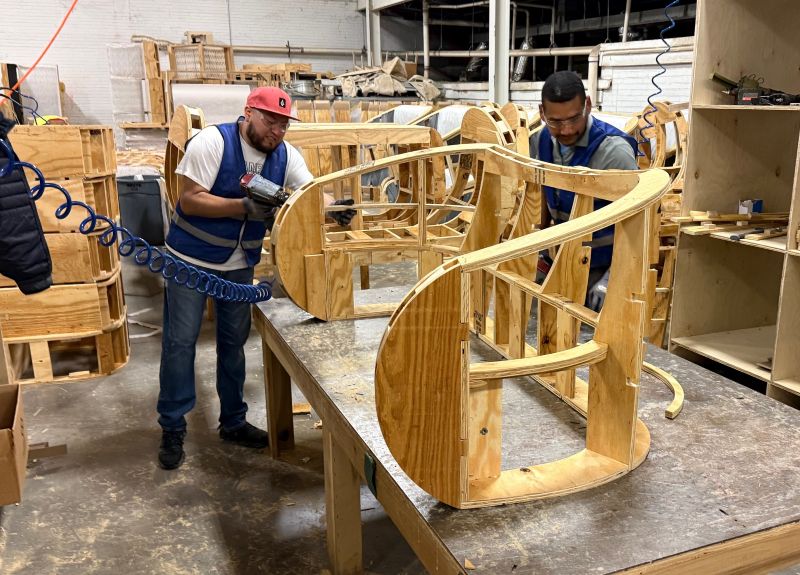
Krinsky, who co-founded wholesaler TOV Furniture with his wife, Chaya, more than 15 years ago, took over the operations of the struggling Vision Contract Manufacturing in High Point about 11 months ago, seeking to fill its available capacity with residential and contract upholstery.
At the time, the 170,000-square-foot operation employed about 45 workers.
But he said in a LinkedIn posted dated Aug. 16 that recruiting new talent was a major challenge and one that contributed to the business not being sustainable.
“There simply aren’t enough skilled upholstery workers at scale,” he wrote. “We looked everywhere. The supply chain is incomplete, and productivity can’t compete with countries built around this industry.”
He also noted that the costs of producing furniture in the U.S. far outweighed the cost of building it overseas. For example, he said that it cost $1,000 to make a sofa in North Carolina versus about $265 FOB in Vietnam.
“That’s not a 10% or 25% problem,” he said in reference to tariffs. “It’s an ecosystem problem.”
But in a reference to the overseas manufacturing of components, he cited another major issue: U.S. Customs, he said, challenged the Vietnamese origin of 17 import entries. To address this, he said, the company provided thousands of pages of documentation. Compiling it and responding, he added, took up more than 100 hours of his team’s time.
“I’ve personally visited these factories, Krinsky noted. “Wood is cut and machined there; frames are built there; fabric and foam are cut there; sewing, upholstery, assembly and packaging happen there.”
He noted that any components that may originate in China are part of a global supply chain and should not be considered transshipment.
“Illegal transshipment is fraud,” he acknowledged. “Go after it aggressively. But legitimate manufacturing is not fraud.”
Still, he said, Customs treated the finished goods as being made in China because it considered the company’s documentation to be insufficient. This resulted in $70,000 in additional China tariffs, which does not include the cost of specialized lawyers. In addition, he said, that certain upholstered furniture is subject to a 25% Section 232 tariff tied to national security.
“What exactly is an American business supposed to do?,” Krinsky said, asking how a sofa is a threat to America’s national security. “I want American manufacturing to succeed and illegal transshipment stopped. But policy has to be based on reality, not slogans.”
He suggested that the U.S. remove the Section 232 tariff, in order to “Give businesses predictability. Punish real transshipment without treating legitimate manufacturing as fraud. If America wants these industries back, build the workforce and supply chain needed to compete.”
“American businesses are not the enemy,” he concluded. “We take the risks, employ people, invest capital and try to build something that lasts.”