
 by
by WalletHub report is based on 22 key metrics applied to 300 cities around the US, including overall affordability, tax rates, utility rates and quality of life
MIAMI — An in-depth analysis by consumer finance specialist WalletHub has identified the best and worst cities for first-time homebuyers based on nearly two dozen key metrics ranging from affordability to crime rates.
The results are based on 22 key metrics applied to some 300 cities around the U.S. Affordability was a major metric, particularly as it determines whether new buyers will be able to qualify for loans and afford the expenses including a monthly mortgage and utilities.
The study looked at large cities with more than 300,000 people along with midsized cities with populations of of 150,000 to 300,000 and smaller cities with populations less than 150,000. Key areas of consideration included affordability (housing, homeowners insurance, cost per square foot and real estate tax rate); real estate market (median home price appreciation, rent-to-price ratio, median days on the market, foreclosure rate, active listings per capita, etc.) and quality of life (job market, weather, quality of schools, violent and property crime rates, and total home energy costs).
The five cities with the most affordable housing were in Flint, Michigan; Detroit, Michigan; Springfield, Illinois; Peoria, Illinois; and Toledo, Ohio. The least affordable were all in California: Santa Barbara, Santa Monica, Glendale, Costa Mesa and Berkeley.
This presents a stark difference between the Midwest and West Coast, and one that is not necessarily ameliorated by higher salaries in one part of the country or the other. The fact is, that to afford a home, many young people likely have to be earning a much higher salary than their parents or upper-income peers, an increasingly challenging task given other expenses ranging from college debt to automobile debt and even the weekly/monthly cost of day care.
The top five cities with the lowest overall cost of living are Flint, Michigan; Oklahoma City, Oklahoma; Amarillo, Texas; Tulsa, Oklahoma; and Des Moines, Iowa. Those with the highest cost of living include four cities in California: Sunnyvale, Santa Clara, Santa Barbara and Thousand Oaks, along with New York City.
Tax rates were another consideration that determine whether younger buyers in particular will be able to budget for the extra money they need to put in escrow each month. For many, this is automatically built into their mortgage payment as they have no prior history of housing payments.
The top five most affordable areas based on real estate tax rates were Honolulu, Hawaii; Scottsdale, Arizona; Colorado Springs, Colorado; Mesa, Arizona; and Montgomery, Alabama. The highest tax rates were in Peoria, Illinois; Waukegan, Illinois; Rockford, Illinois; Waterbury, Connecticut; and Paterson, New Jersey.
Energy rates were another consideration. The top least expensive in this area included Baton Rouge, Louisiana; New Orleans, Louisiana; Boise, Idaho; Reno, Nevada; and Davenport, Iowa. The most expensive were Honolulu, Hawaii; Bakersfield, California; Roseville, California; Elk Grove, California; and Sacramento, California.
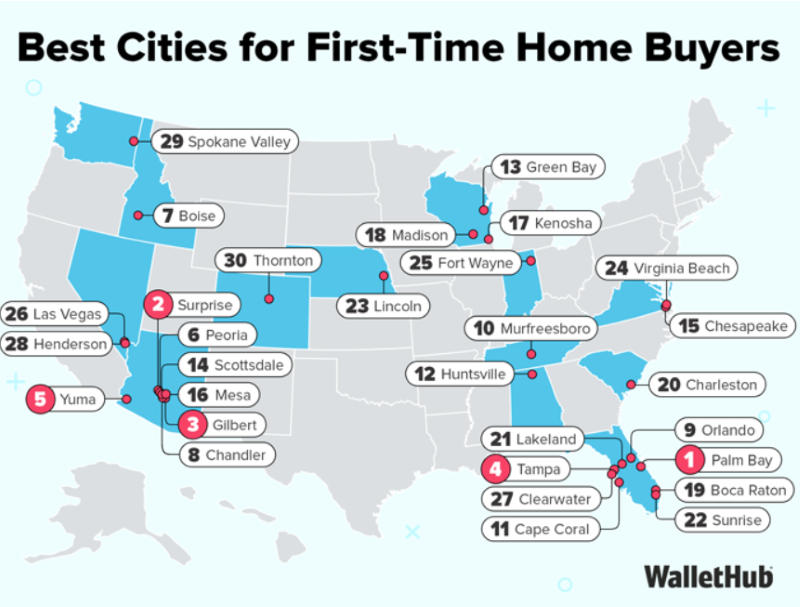
The survey identified the overall best cities for first-time buyers as Palm Bay, Florida; Surprise, Arizona; Gilbert, Arizona; Tampa, Florida; and Yuma, Arizona. With the exception of Anchorage, Alaska (ranked 296), the worst five cities on the list were all in California, including Oakland, Santa Barbara, Santa Monica and Berkeley.
“Buying a home for the first time is a very stressful and difficult process, especially when housing prices are through the roof and interest rates have risen sharply in the past few years,” said Chris Lupo, an analyst with WalletHub. “The best cities for first-time homebuyers not only are affordable both in terms of buying a house and living there afterward, but they also have a lot of housing choices as well as low crime rates and good schools.”
He went on to further describe what this means for the furniture industry.
“First-time homebuyers are one of the biggest customer segments for the residential furniture industry because purchasing a home often leads to furnishing multiple rooms at once,” he said. “However, with first-time buyers making up just 21% of the housing market last year, compared to the historical average of 40%, retailers should expect demand from this group to remain more limited than normal.
“Considering the national trend, it will be increasingly important to focus on markets where first-time homebuying remains relatively strong. Cities like Palm Bay, Florida; Surprise, Arizona; and Gilbert, Arizona stand out because they combine active housing markets with significant new construction, creating a steady stream of households that are likely to be shopping for furniture.”
“At the same time, affordability remains a major challenge, so retailers that offer a range of price points or financing options will likely be better positioned to attract buyers who have already stretched their budgets to purchase a home,” he added.
Thus, as younger generations buying a home for the first time are an important segment for furniture spending, the survey results help put perspective on which cities and regions offer them the most livable environments over the short and long term. For many, the overall rankings could determine what areas attract the most young consumers, how long they are likely to stay in certain areas and whether they are even able to afford buying a home there in the first place versus renting.
For the full report, including further specifics about the methodology, click here.