 by
by Upholstery manufacturer continues to operate according to long-established principles under its new private ownership structure
CAIRO, Ga. — When Solstice Sleep Products acquired residential upholstery manufacturer Woodhaven in early 2025 from the Aaron’s Company, it marked a major investment into a highly respected resource with history dating back to 1971.
In its initial 54 years the company operated as the exclusive manufacturer for the publicly owned lease-to-own specialist Aaron’s, initially as MacTavish Furniture, founded by Charlie Loudermilk. Then in 2010, it changed its name to Woodhaven Furniture, which reflected its commitment to sustainable manufacturing.
Today that core tenet remains, with sustainable practices — ranging from the use of skylights and LED lighting to lessen power demand — to the use of excess wood for heating and the use of scrap materials to make recycled padding.
But other core principles also have remained unchanged in its transition to private ownership, including product stewardship, which the company describes as a commitment to maintaining continuity in its operations in the event that a machine, supplier or other key operation of its business comes off line. Amid these and other disruptions, the company said it remains poised and prepared to continue running, so shipments don’t slow down.
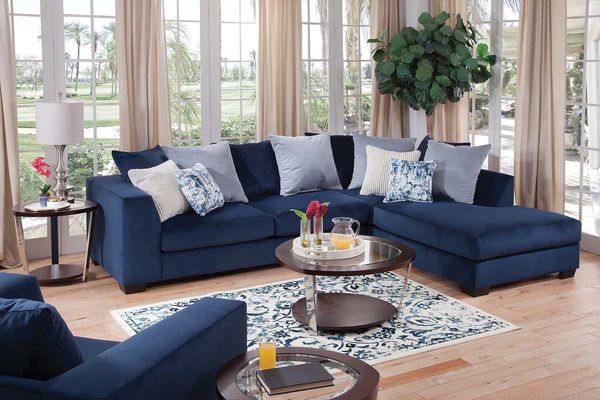
These principles are a guiding force for its estimated 700,000-plus square feet of manufacturing and distribution in and around Cairo Georgia. Combined with its administrative offices, these facilities employ about 340 workers, with 90% of those in manufacturing and distribution and the other 10% on the office/administrative side of the business.
Operations are highly vertical in nature, as it produces 100% of its frames in house and also cuts its own foam, meaning it controls most of its own production, which in turn helps speed up shipping times. While it imports much of its cut and sew kits from countries such as Vietnam, the Dominican Republic, Mexico and Turkey, it also cuts some of its own fabric in house, providing a quick turnaround on these materials as well.
During a visit to its facilities in southern Georgia in early April, Home News Now met with company President Tommy Harper, who explained the importance of sticking to its core tenets and standards regardless of its ownership structure, public or private.
“We maintain that because it makes us a stronger company and also provides better product for our customers,” Harper told Home News Now. “There are enough of us still on the management team here now that operated within those guardrails that we maintain today with all these checks and balances. It is something that we continue to foster even though we have changed from a public company to a private company…They are all the same principles that have made us who we are and how we develop and build the products we produce, but also the way we service our customers. So it’s all about safety, quality and service and cost is last. Take care of your people and your business partners and if you do that, your business will be successful. Those are really our core tenets.”
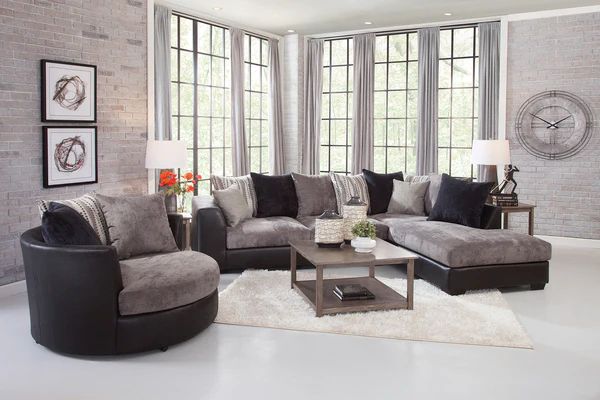
Now operating under a new corporate entity called Woodhaven Enterprises, Harper noted that the company not only has its primary management team in place, but also has been given more resources and leeway from its new owners to continue operating according to its core tenets.
“So a lot of the big changes that we have had in the past 15 months have been really positive from the perspective of re-invigorating our operation and our core mission,” Harper added. “It was very clear to me from the board of our private ownership — do not change your quality and do not change your level of service. If anything improve them. And really that is our mission today.”
But coming from the public realm benefited the company and its customers particularly from a product stewardship standpoint. In addition to being prepared in times of upheaval, it also has meant making sure its entire product line has met every state and federal standard possible ranging from CARB regulations regarding frame materials to TOSCA rules dictating the type of glues it could use in its assembly process.
In addition, it had to meet high quality standards because of its focus on the lease-to-own business. As sofas, sectionals and other seating would typically be rented for use in multiple homes, the construction, seating and fabrics all had to hold up in order to live out its full lifecycle.
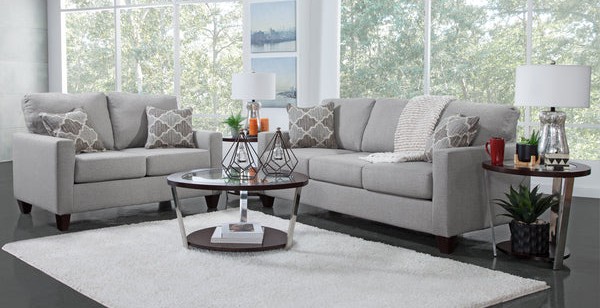
Priced in the mid to upper middle segment of the business, the company produces sofas that retail from $499 to $999 with some being as high as $1,199 and sectionals that retail for around $599 for a sofa and chaise to $1,999 for a larger sectional.
It hits these price points with a model focused on larger production runs versus custom orders that are typically produced one at a time for designers and their clients.
For years its focus on larger production runs served the needs of Aaron’s and other retailers looking for consistency and quality at a good price.
Today, Aaron’s remains an important customer. However, the focus today is more on growing the business with individual brick and mortar accounts, some of which were concerned that the company would shortchange them if business at Aaron’s picked up.
“We understand every customer is important and to grow, we have to give every customer the same level of service and quality,” Harper said. “We can’t sacrifice service. I heard this for years as we tried to sell brick-and-mortar retailers, ‘What is going to happen if Aaron’s gets busy? You are going to cut me off and keep servicing them.’”
Actually, he said the opposite was true during the peak of Covid-related demand when the company was shipping a 30% increase in orders.
“Even though Aaron’s ramped up during stimulus, we actually increased our shipments to our partners going into this period…It is important for us to take care of every customer, no matter what volume of business they are doing or what products they are buying. But the focus is to grow our business and to grow it profitably. We are actively trying to grow our business with Aaron’s, but we also want to — as any healthy company would — diversify our customer base as well, and we can do both things. We can diversify and make our company stronger.”
Today, Harper said, Woodhaven continues to recruit additional resources to help grow beyond its core business with Aaron’s. This includes the hiring of merchandising expert Jeannie Corey as vice president of merchandising this past January and also the hiring of industry sales and business development veteran Phil Devero last September.
“We want to make sure we are building our organization, our team and our resources to be able to give a high level of support to all of our customers,” Harper said. “That’s really what our focus and our mission is all about.”

From Devero’s perspective, being able to share Woodhaven’s domestic manufacturing story and quality level is an exciting part of the process as is growing the sales team in recent months.
“This is a true made-in-the-U.S. story,” Devero said of the vertically integrated nature of the operation that includes building its own frames and cutting its own foam.
Its estimated three-week lead time is another angle to the story that offers a compelling alternative to imports that need at least an additional 30 days on the water after they ship from the factory.
“By the time they get our merchandise, they probably have had two turns while they are still waiting on a container from someone else,” he added.
“It definitely makes a difference and we are making progress from a retail standpoint. We are going to just build one success story after another.”
The synergies with its parent company are another advantage as the company has, or will have the ability to ship on mixed truckloads with mattresses sold by sister company Jamison Bedding, which has warehouses in South Carolina, Ohio and just outside Dallas, Harper noted.
“We already have some programs like that with some of our larger customers and are looking at how do we continue to develop it,” he added. “It’s a big freight advantage for our customers. Let’s just say we get 150 seats on a truck with upholstery. We may get another 40-50 mattresses without losing one seat of upholstery.”
Other areas of opportunity are to continue developing and recruiting talent to the organization whether it be on the administrative or production side of the business.
Being situated in southern Georgia has its challenges and advantages. While there is not a big pool of experienced workers in upholstery to draw from, it also doesn’t face competition from other upholstery producers trying to hire away its talent. Plus, new employees also don’t come in having to relearn what they already have learned working for another upholstery producer.
“We have competition, but there is not another sizable furniture company within a few hundred miles of us,” Harper said. “That really gives us an advantage of when an employee comes to us for a job, they know nothing about building product, and we have our own levels of product quality and standards. So we have a blank slate to teach those people how to build product and to focus on the specifics that are important to us and our customers. And that also gives us a huge advantage. From an employee retention perspective we don’t have to worry about our team members who have spent years training, leaving us to drive down the street and working for one of our competitors.”
And many employees tend to stay years if not decades at the company.
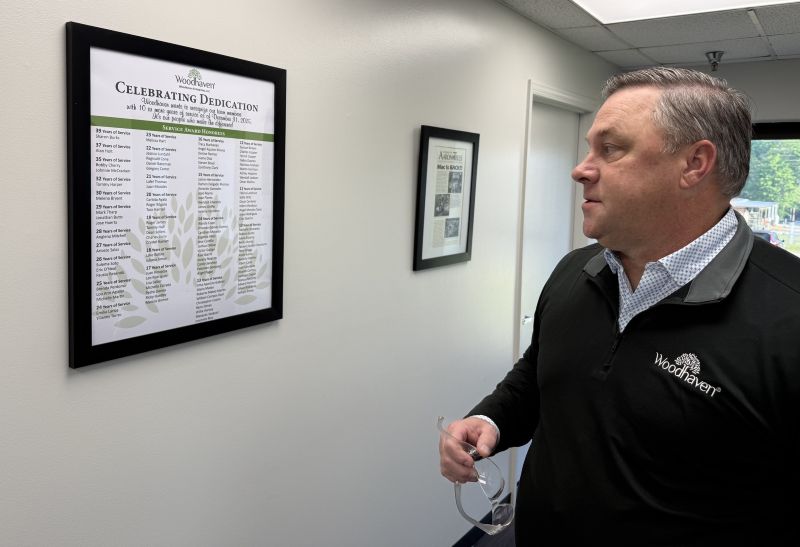
That includes Harper himself, who has worked for Woodhaven for 32 years starting out of college as a member of the production staff then working his way up to production manager, plant manager, general manager and vice president, manufacturing.
His inspiration has been the opportunity and level of support he has had from so many others in the organization and the team that today is making things happen for Woodhaven and its customer base.
“It took a lot of great people to build this organization and operation into what it is today, and in a big sense I feel like I am a steward of that,” he said. So part of my mission is to continue this operation and foster the culture where 30 years from now someone sitting at this table or one like it will be talking about us and our contributions.”
“All these people that you see walking through the factory own this place as much as any of the rest of us, and that’s the way we treat it,” he added. “And we basically take part in the ownership of this. We own the product and we own the level of service and that is instilled from my position all the way down to the guys loading the product on trucks.”