
 by
by Affordability is a key component of the legislation that will determine whether people will be able to buy a new or existing home
WASHINGTON — The passage of the 21st Century Road to Housing Act could be significant to the furniture industry as it has some key provisions that could expand opportunities for homeownership in the months and years ahead.
Stating the obvious, new and existing home sales drive furniture sales perhaps more than any other single economic event other than one’s securing a new and better paying job.
In passing this legislation, which became law this past weekend, Congress acknowledged a long and enduring barrier to homeownership: affordability.
It’s a word, that appears at least 34 times in the 300-plus-page bill, while the term affordable appears 104 times minus their respective mentions in the table of contents. In either case, the goal is to streamline processes and facilitate measures that make housing more attainable by the general public.
Of course, affordability is a relative term based on one’s income and the price of housing in the area where one lives and works.
The bill specifically identifies affordable housing as “housing for which the monthly payment is not more than 30% of the monthly income of the household.” Putting this in context, this percentage is slightly higher than a current recommendation that homeowners spend no more than 28% of gross income on a mortgage, including principle, interest, taxes and homeowners insurance, with the total debt not exceeding 36% for a mortgage, car loans and student loans.
According to figures from the U.S. Census Bureau mined with the help of AI, the median price of a new single-family home in the U.S. is $424,900, compared with $246,500 in 2006, “far outpacing both inflation and wage growth over the same period.”
By comparison, the median sales price of an existing single-family home is currently $440,600, compared with $230,000 in 2006, according to the Federal Reserve Bank of St. Louis.
Below is a graph showing how monthly mortgage payments have risen over the past 55 years.
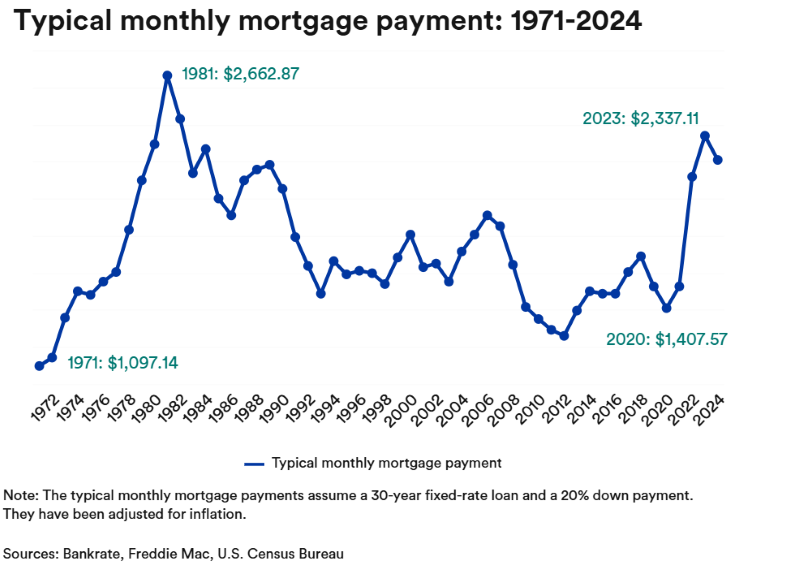
Last year, Bankrate’s Housing Affordability Study reported that prospective homebuyers need an annual income of about $117,000 to afford a median-priced home in the U.S.
Thus, the rising cost of housing has made owning a home extremely difficult, particularly for those just starting out in their careers.
And the idea of making it in today’s economy is not just about housing costs. Other expenses such as health and auto insurance, groceries, clothing, day care and the need to pay down other debts such as student loans, have made owning a home unattainable for many. This is also true of other things like expensive vacations, dining out and other forms of entertainment, not to mention buying new furniture, although we would classify the latter as a need versus a want.
Among the provisions regarding affordability, there is an entire section devoted to institutional investors, with specific language that — with certain exceptions — prohibits large institutional investors controlling 350 or more single-family homes from purchasing, or entering into a contract to directly or indirectly purchase, any single-family home. Exceptions include build-to-rent and renovate-to-rent properties that must be sold to individual buyers within seven years. This would potentially open up the number of properties on the market and make them available to more consumers over the short and long term.
Housing industry officials shared their thoughts on the legislation on Friday.
“NAHB applauds Congress and the Trump administration for delivering a bipartisan housing victory for the American people,” said Bill Owens, chairman of the National Association of Home Builders and a homebuilder and remodeler from Worthington, Ohio. “Strong support in both chambers makes clear that housing affordability is a national priority. By reducing regulatory barriers, helping builders increase supply, and expanding opportunities for homeownership and rental housing, this landmark law is an important step toward easing the nation’s housing affordability crisis. We look forward to working with the administration and Congress to implement it.”
Adds Shannon McGahn, chief advocacy officer of the National Association of Realtors:
“On behalf of more than 1.4 million Realtors, we thank the members of Congress and the administration who came together to advance legislation that will benefit families and communities in every congressional district and ZIP code across the country. The 21st Century ROAD to Housing Act reflects years of bipartisan work and a shared commitment to addressing one of America’s most pressing challenges.
“This law combines nearly 50 carefully negotiated measures to increase housing supply, improve affordability, expand access to homeownership, strengthen housing finance and support veterans. For Realtors, this law is more than a legislative victory. It shows what sustained advocacy and bipartisan leadership can accomplish to expand housing opportunities and strengthen communities nationwide.”
The degree to which this legislation makes homeownership more attainable will depend not just on the implementation of the bill itself, which could take several years. It also will depend on other factors such as the strength of the job market and cost of building materials, combined with other inflationary pressures in the marketplace, ranging from interest rates to the cost of fuel and other necessities. As always, furniture also needs to remain competitively priced in order for new homeowners to afford what they need to furnish their homes.
But if it accomplishes what it has set out to do, the 21st Century ROAD to Housing Act should be a good starting point to making more homes available and affordable to more consumers.