
 by
by GREENSBORO, N.C. — Visual commerce expert Intiaro has released findings from its proprietary pAIn survey, a research initiative designed to uncover the most pressing operational, sales and marketing pain points across the furniture manufacturing landscape.
The pAIn survey was developed and authored by CEO Pawel Ciach to help the Intiaro team listen more closely to its primary customers— furniture manufacturers — and use that feedback to continually evaluate and enhance its visual commerce platform and services. The results also provide a snapshot of an industry navigating increasing complexity, tighter margins and rising expectations from retailers and consumers alike.
The survey results reflect input from more than 50 executives and senior leaders across sales, marketing, operations and information technology, representing over 30 leading furniture brands. Together, their responses paint a clear picture of where the industry is investing — and perhaps more importantly, where execution appears to break down.
One of the most consistent findings of the pAIn survey is that resistance to digital transformation is no longer the issue. Most respondents reported plans to maintain or increase spending on digital technology, with ERP upgrades, new platforms and internal tools already underway. Yet despite this investment, execution remains uneven.
“We’re continuing to invest, but improving efficiency and reducing friction across operations is just as important as growth,” said Comer Shuford Wear, vice president of marketing, Century Furniture, which is partnered with Intiaro along with the Rock House Farm Family of Brands.
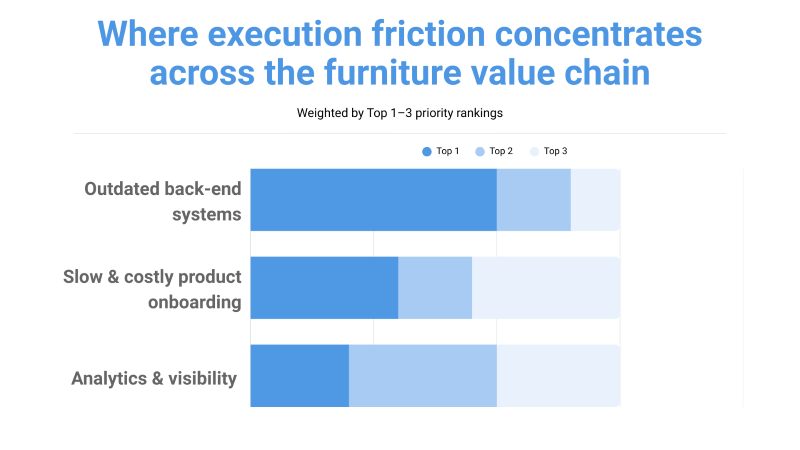
Back-end systems and integration challenges emerged as the top constraint
Outdated infrastructure and poor system connectivity ranked higher than any other category, regardless of company size or business model. While data existed, it did not move cleanly between teams or tools. Difficulty transferring information between systems directly impacted launch timelines, analytics visibility and customer-facing processes.
Slow on-boarding and product launch processes followed closely behind.
Product on-boarding and launch ranked among the most painful areas overall. Respondents emphasized that product readiness was rarely the issue. Coordination was. Products were often technically sellable well before they were usable across websites, dealer portals, sales tools and partner platforms.
“The defining pattern of 2025, according to the survey, is a disconnect between strategic intent and operational follow-through. Change is not being blocked but rather slowed as it moves through organizations,” said Ciach.
Two additional priorities ranked equally high based on the survey
One centered on customer service and order-handling overhead, where manual corrections, errors and repeated clarifications were common. These issues typically did not originate within customer service itself but surfaced when upstream systems failed to align product data, configuration options, pricing and availability.
The other focused on analytics and visibility lagging behind decision-making needs. Leaders acknowledged that while analytics is recognized as important, it is frequently deprioritized because accessing reliable insight requires too much manual effort. As a result, many decisions continue to be made with incomplete or delayed data.
According to Intiaro, the most painful challenges identified in the survey are not isolated issues. They are different expressions of the same structural problem: systems, data and workflows exist, but they do not move cleanly across teams or stages of the product lifecycle.
Ciach said, “We believe success for furniture manufacturers in the coming year will not be defined by who invests the most. It will belong to those who reduce friction between systems and shorten the distance between decision and execution.”